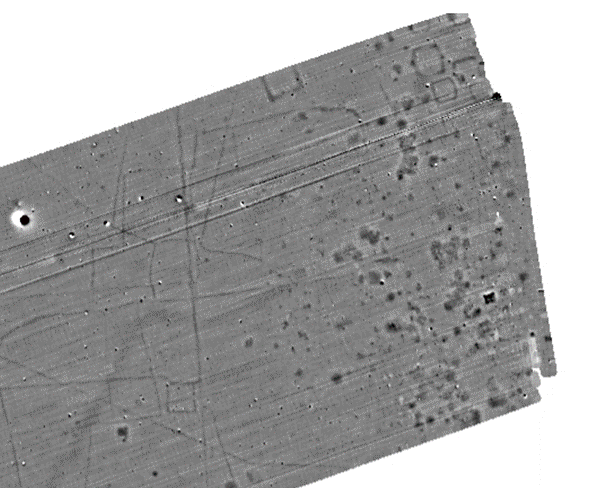
The magnetic research method is one of the most productive non-destructive geophysical methods, widely used in archaeology, geological exploration, unexploded ordnance (UXO) clearance, and in cases where the goal is large-area imaging and data acquisition. Magnetic prospecting belongs to the potential methods.
During the measurement, the magnitude of the ambient magnetic field (resultant or component level) is measured at specific points. From these measured points, a magnetic anomaly map is created. The ambient magnetic field can be considered as a resultant field, which is the sum of the Earth's natural magnetic field and the magnetic (remanent) anomalies present at the given measurement point. Individual anomalies either strengthen or weaken the Earth's natural magnetic field. By plotting the measured magnetic values with correct coordinates, we obtain a result excellently suitable for mapping buried structures. The measuring instrument used for magnetic prospecting is the magnetometer. Magnetometers can operate based on several measurement principles (fluxgate, proton precession, Overhauser, cesium). The applied measurement principle somewhat influences the resolution and sensitivity of the instrument, as well as the nature of the measured data (field component or resultant field). However, it can be stated that for all magnetometers, the presence of strongly magnetizable materials (ferromagnetic) limits the feasibility of the measurement. In the vicinity of large and strongly magnetizable materials, sensitive probes saturate, thus the instrument "blinds" in the wider environment of such bodies. This phenomenon is the greatest limitation of the method's applicability. Due to this, with a few exceptions, the magnetic research method is most effectively applied in so-called "greenfield" areas. Regarding the measured field value, we can talk about total field measurement and gradient measurement. In the case of total field measurement, the absolute value of the ambient magnetic field is measured. The advantage of this is that longer wavelength (geological) changes in space can be well followed with it, but the disadvantage is that high-frequency noise near the surface is more pronounced in the measured data. A further disadvantage is that the evaluation of absolute field measurements requires data from a base station instrument installed for the duration of the measurement. The base station instrument measures the temporal changes of the global magnetic field, which are influenced by the Earth's rotation cycle, solar wind activity, and the state of the ionosphere. The data measured by the base station instrument must be used as a correction.
During gradient measurement, two sensors at a given distance from each other measure the absolute value of the ambient magnetic field, and then the difference between these field values is calculated. The value thus obtained is the gradient. The geometric arrangement of the sensors can be horizontal or vertical. The advantage of gradient measurement is that no base station instrument needs to be installed, as the temporal changes of the global magnetic field are eliminated by the difference calculation. A further advantage is that the measurement setup is less sensitive to disturbances near the surface. The disadvantage of gradient measurement is that it smooths out larger scale (e.g., geological) changes. Due to its rapid evaluation and noise suppression capability, its popular application areas include archaeology and UXO clearance.
Application areas:
- Archaeological surveys
- Tank detection
- Utility mapping
- Mine surveys
Advantages:
- Fast and efficient data acquisition over large areas (~10 hectares/day)
- Mobility: our equipment can be towed by vehicle in ideal terrain conditions
- Can be performed without harming the environment
- Due to the high sensitivity of the measuring instrument, the presence of small magnetizable materials can also be well mapped.